
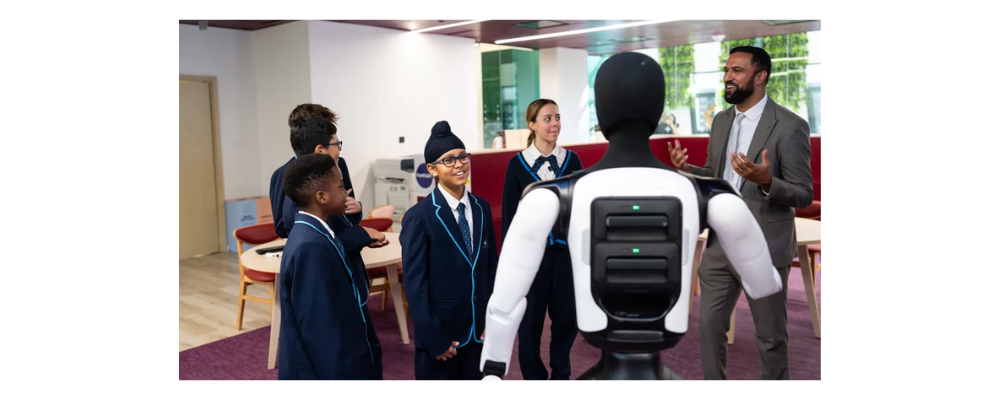
GEMS Education and Dubai-based robotics company MANGOBOT are launching a new learning initiative that will give students hands-on experience with AI-enabled humanoid robots. Starting at GEMS School of Research and Innovation in January 2027, teacher-driven activities will help evaluate the educational value, safety and potential future applications of embodied AI.
Learning by building, testing, and questioning
SRI will operate as the physical launchpad and research hub. Evidence from student work, teacher observations and structured industry evaluation will determine whether individual use cases should be continued, adapted or considered for carefully governed expansion across the GEMS network alongside input from research professionals. The planned learning programme will cover programming and movement, sensors and perception, language models, human–robot interaction, engineering, ethics, privacy and safety.
Working alongside teachers and MANGOBOT engineers, students will explore how robots move, respond to instructions and interact with their surroundings. In an initial activity, students will program a controlled movement sequence, test how accurately the robot follows their instructions, identify where its behaviour differs from what they intended, and refine the program accordingly. They will also begin testing controlled language interactions, examining how the robot responds, where errors or uncertainty occur, and when human judgement is needed.
All student-facing activity will take place within designated learning environments under the supervision of teachers or trained adults. Before any use case is made available to students, GEMS will approve its educational purpose, permitted functionality, knowledge sources and interaction boundaries. Age-appropriate access controls, privacy and safeguarding requirements, physical operating boundaries and human override procedures will be in place from launch. Teachers and authorised staff will retain the ability to pause or stop an interaction or withdraw a use case at any point.
The collaboration will also encourage students to ask more fundamental questions: How do intelligent machines make decisions? When can their responses be trusted? And where should human judgement always take precedence?
Baz Nijjar, Senior Vice President Innovation, AI and Futurism, GEMS Education, said: “Our children will grow up in a world where intelligent machines are increasingly part of everyday life and work. But preparing them for that world cannot simply mean teaching them how to use the technology. They need to understand how it works, how to challenge it, and how to make informed decisions about where it belongs.
That is what makes this collaboration exciting. Our students will have the opportunity to build, program and test humanoid robots alongside their teachers and robotics experts. And just as importantly, we want them to discover what these machines cannot do, and why human judgement, creativity and responsibility will matter even more as the technology advances.”
MANGOBOT will contribute its robotics integration expertise and work with GEMS to develop educational applications using humanoid robotics technology from MANGOBOT. GEMS will determine the educational content, approved knowledge sources and student-facing interaction boundaries, with MANGOBOT configuring the technology to operate within those requirements.
The technology pathway includes platforms such as the X2 and D1 Max models and the new A3, with final platform selection and enabled capabilities subject to the requirements of the educational programme and school safety approval.
Karim Abu Alragheb, Founder and Chief Executive Officer, MANGOBOT, said: “MANGOBOT was founded in Dubai to turn advanced humanoid robots into useful, trusted real-world solutions. This partnership allows us to combine our integration expertise and strategic relationship with GEMS’ educational leadership, safeguarding, and direct insights from students and teachers. Together, we are not simply placing robots in schools; we are creating a safely governed, programmable environment where young people can learn how embodied AI works and help shape how it should serve society.”
Giving students a role beyond STEM
To widen participation beyond STEM-track students, GEMS and MANGOBOT will launch a set of short-term extracurricular clubs at SRI that use the robot as a creative and cultural platform first and a technical one second.
At the Fashion Design Workshop, students will design, fit, and dress the robot, exploring textiles and styling through a wearable-tech lens. At the Robo-Dance Training Club, students will choreograph and train movement routines, pairing performance arts with motion programming. Culture Storytelling will see students script and voice the robot to narrate local heritage and folklore, blending narrative craft with human-robot interaction. Meanwhile, Design a Robot Character will have students build alternative personas, voices, and characters for the robot, exploring creative writing, and customisation, whilst understanding all this is artificially curated
Building future capabilities through an AI & Robotics Training Academy
Building on the initial collaboration, GEMS School of Research and Innovation and MANGOBOT will also work towards establishing a joint AI & Robotics Training Academy at SRI, focused on upskilling students, teachers and professionals in AI, robotics and embodied intelligence.
The Academy will position SRI as a hub for both human capability development and the responsible advancement of AI and robotic systems. Following completion of the partnership’s first phase, GEMS and MANGOBOT plan to develop structured training and certification programmes that bring together educational expertise, industry knowledge and hands-on experience with emerging technologies.
Supporting Dubai’s ambitions in robotics and future skills
The initiative brings together two priorities shaping Dubai’s future: advancing practical capabilities in robotics and AI and preparing young people to understand and use emerging technologies responsibly. It aims to contribute to the talent development and research ambitions of the Dubai Robotics and Automation Programme, while supporting the learner-centred innovation and future-skills priorities of Dubai’s Education 33 strategy.